
Test & listen
We confirm hardness and learn what you notice around the home.
Local water treatment specialists
Salt Lake City water is very hard at around 13 grains per gallon. Get a properly sized system installed for $2,699 to help protect your fixtures, appliances, skin, hair, and daily routine.
Our direct rate
Why do national brands charge up to $8,000 for a water softener?
| What You Pay For | Our Direct Rate | The Big Franchise Competitors |
|---|---|---|
| Premium Water Softener | Included | Included |
| Professional Installation | Included | Included |
| Multi-Tier Sales Commission | $0 (No pushy salesmen) | $1,500 – $2,500 |
| National Franchise Fee Markup | $0 (Locally optimized) | $2,000 – $3,500 |
| Massive TV & Billboard Advertising | $0 (Digital direct) | $1,000 – $1,500 |
| Total Out-of-Pocket Cost | $2,699 | $7,500 – $8,500+ |
You don’t need a corporate boardroom’s permission to protect your home’s plumbing. Get the exact same pro-grade limescale protection without the franchise tax.
📞 Lock In Your $2,699 Fixed Price Now100% transparent pricing. Licensed local pros. Zero hidden fees.
Soft water, made simple
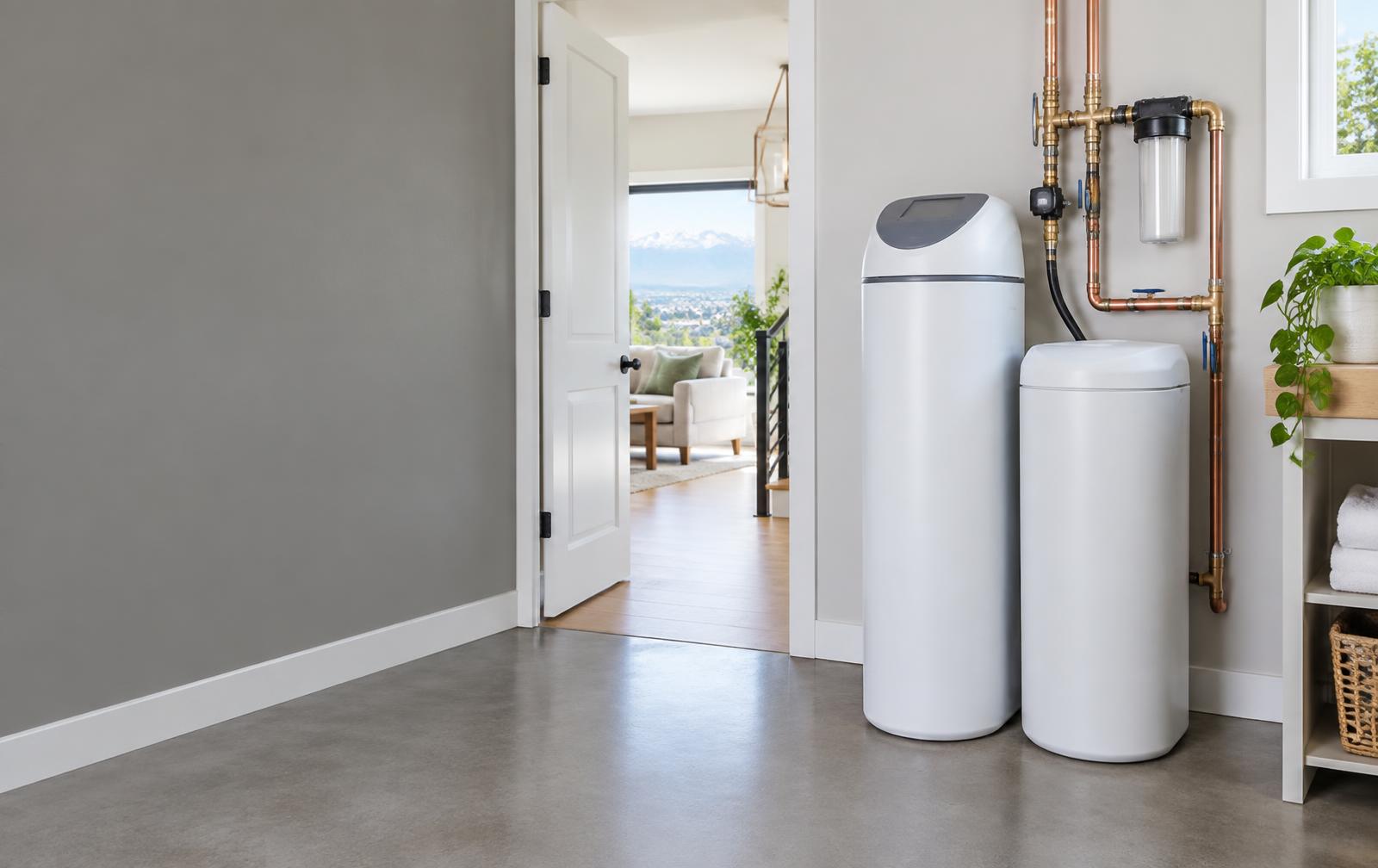
A water softener removes dissolved calcium and magnesium before they travel through your home. That means less scale on faucets and shower doors, fewer spots on dishes, softer-feeling skin and hair, and less mineral stress on water-using appliances.
We help you choose the right capacity and efficiency for your home, then install and program it for Salt Lake City’s local hardness—not a generic factory setting.
A whole-home water softener is designed to reduce the calcium and magnesium that make Salt Lake City water feel hard. The equipment is installed where water enters the home so treated water can reach showers, sinks, laundry equipment, the dishwasher, and the water heater. Instead of trying to clean mineral residue after it appears, the system addresses hardness before those minerals move through the plumbing. That is why correct placement, sizing, drainage, and programming matter as much as the equipment itself.
Salt Lake City Water Systems provides a complete water softener installation for $2,699. Before scheduling, we review the available plumbing, the location of the main water line, nearby drainage, electrical access, household size, and the way your family uses water. These details help determine whether the proposed setup can provide steady soft water without regenerating more often than necessary. The goal is a practical installation that fits the home and is easy for the homeowner to understand and maintain.
An installation should solve a real household problem rather than simply add another appliance. We explain where hardness is showing up, what softening can improve, and what it cannot do. A softener addresses hardness minerals; it is not a substitute for a filter selected to handle a different water concern. Clear expectations help homeowners choose the right treatment and avoid paying for equipment that does not match the problem.
Salt Lake City water is commonly around 13 grains per gallon. That reading falls in the very hard range and represents a substantial amount of dissolved calcium and magnesium moving through the home each day. Hardness is not usually noticed as a single dramatic event. It appears gradually as white crust around faucets, a rough film on shower doors, spots left on dishes, and deposits that return soon after cleaning.
The effects also show up in daily routines. Soap and shampoo can be harder to rinse, skin and hair may feel dry, towels can feel less soft, and laundry may look dull. Inside the home, scale can form on heating elements and narrow water passages. A water heater or dishwasher may need to work around that buildup, and repeated mineral stress can shorten the useful life of water-using appliances. Softening does not erase old scale immediately, but it helps stop new hardness deposits from continually forming.
Because hardness varies by water source and can be affected by a home’s plumbing, testing at the property is useful. We compare untreated water with treated water after installation. This provides a baseline for programming and a straightforward way to confirm that the system is doing its job.
Water softeners are not sized by square footage alone. The number of people in the household, typical daily water use, peak flow through several fixtures, and measured hardness all influence capacity. A system that is too small may regenerate frequently and use more salt and water. A system that is unnecessarily large may cost more without providing a practical benefit. We use household conditions to recommend a balanced capacity.
Programming matters after sizing. The hardness setting tells the control how much treatment capacity is used as water passes through the resin. Salt dose and reserve capacity affect how the unit prepares for the next cycle. For local water around 13 grains per gallon, a generic setting can be inaccurate. We set the controls for the home, initiate a cycle, inspect the drain flow, and test the treated water before considering the job complete.
We also consider the plumbing layout. A bypass lets water continue to the home if the softener needs service. The drain must handle regeneration flow safely, and connections should remain accessible. Thoughtful placement makes it easier to add salt, inspect the equipment, and perform future maintenance without disrupting the surrounding space.
The work begins by confirming the planned location and protecting the nearby area. Water is shut off while the new connections are made. Where a suitable plumbing loop already exists, installation may be direct. Homes without a loop can require additional routing, which is why the plumbing review happens before scheduling. The softener, brine tank, bypass, drain, and overflow are positioned so the system can operate safely and remain serviceable.
After the connections are complete, we restore water carefully and check for leaks. The system is programmed for the household and local hardness. We run the appropriate setup cycle, observe the drain, and test water downstream of the softener. The final walkthrough covers the bypass, salt level, display, and the simple signs that indicate normal operation.
Many straightforward installations can be completed within a day, although access and plumbing changes can affect timing. We do not want speed to come at the expense of clean connections or a clear homeowner handoff. You should know what was installed, why it was configured that way, and what routine attention it needs.
The most noticeable changes often happen at sinks, showers, and the dishwasher. New scale should slow substantially, soap may lather more easily, and rinsing can feel different. Existing deposits on fixtures and glass still need to be removed, so improvement is easiest to judge after those surfaces are cleaned. The water heater may also contain old sediment or scale that does not disappear immediately.
Routine care is simple but important. Keep enough salt in the brine tank for the next regeneration while avoiding the habit of packing it to the top indefinitely. Break up a salt bridge if a hard crust forms over an empty space. Look occasionally for an unexpected leak, a disconnected drain, or a display warning. If water begins to feel hard again, a quick hardness comparison can separate a settings issue from a mechanical problem.
Salt use varies with household water use, hardness, and system settings. Efficient demand-based regeneration responds to actual use rather than running on a fixed schedule whether capacity has been used or not. Correct programming supports consistent results while limiting unnecessary salt and water consumption.
The complete water softener installation price is $2,699. We state that amount plainly throughout this website so homeowners can evaluate the project without searching for the number. Before scheduling, we confirm the condition of the installation area and the plumbing requirements. That review prevents confusion about whether the home is ready for the planned work.
Price is only one part of the decision. Correct sizing, accessible placement, reliable drainage, accurate programming, and a clear handoff determine whether the installation continues to perform. A poorly matched unit may regenerate too often or allow hardness through during high use. A neat, correctly configured system is easier to live with and easier to service later.
If your existing system is not working, repair may be a better value than replacement. If a tank is leaking, major parts are unavailable, or repairs have become frequent, replacement may make more sense. Our repair and replacement pages explain those choices in more detail, and a hardness test can provide objective evidence before you decide.
Start with the problem you want to solve. If the main concerns are scale, spotting, difficult rinsing, and very hard water, softening is the direct whole-home treatment. If the concern is taste, odor, sediment, or a specific substance, filtration may be appropriate instead of or alongside a softener. Testing keeps these categories clear.
Ask how the proposed capacity relates to your household, what hardness setting will be used, where regeneration water will drain, and how the bypass works. Ask what you need to do after installation and how to recognize a loss of performance. Useful answers should be specific to the home, not a list of vague promises.
Salt Lake City Water Systems keeps the process homeowner-friendly. We focus on the local hardness level, the home’s actual layout, and the daily result you want. Call +1 (385) 993-4196 or use the static quote form to share your address and preferred installation timing.
A clear plan should leave you confident about the purpose of the equipment, the $2,699 installation cost, and the basic care it will require. That clarity is part of a successful installation, not an optional extra. It gives your household a useful reference for evaluating results after the first week, month, and season of normal water use.
A properly sized softener handles Salt Lake City's 13-grain water for one flat installed price.
Fixed $2,699 installation price. Work performed by a licensed plumber.
The installation process
We confirm hardness and learn what you notice around the home.
Household size, plumbing, flow, and 13-grain local water guide selection.
The softener, bypass, drain, and connections are fitted with care.
We program the unit, verify soft water, and show you simple upkeep.
Getting ready
Every installation is performed by a licensed plumber. A few simple conditions around the home make the visit faster and help avoid surprises on installation day.
We confirm your home's plumbing and setup before anything is scheduled. These notes are practical guidance—not a guarantee that every home qualifies without changes.
Installed investment
A complete Salt Lake City water softener installation costs $2,699. We confirm your home’s plumbing and installation requirements before scheduling the work.
Why treatment matters here
White crust on faucets. Hazy shower doors. Spots on clean dishes. Dry-feeling skin and hair. Hardness minerals can also collect inside water heaters, dishwashers, and other appliances, reducing efficiency and shortening useful life.
Read the local hard water guide →Common questions
Local water is around 13 grains per gallon, or roughly 222 parts per million, which is classified as very hard.
Many straightforward installations can be completed in a day. Plumbing access and any required updates can affect timing.
Sizing depends on household water use, number of people, peak flow, and the measured hardness—not simply the size of the house.
A softener prevents new hardness scale. Existing deposits still need cleaning, but ongoing buildup should be greatly reduced when the system is working correctly.